Showing posts with label design. Show all posts

Saturday, December 31, 2022

Solution Engineering Training Opportunity

 If you're following me on Twitter, you've probably seen my announcement a few days ago, about me offering to train 1-2 people to become competent IT Infrastructure Solution Engineers (SEs). I wanted to announce this during BarCamp Kuwait 10 two weeks ago, but didn't to prepare things in time.


SE Basics: What, How and Why

What is a 'Solution Engineer'?

A solution engineer is someone typically working at System Integrators in the IT industry, or at IT companies (vendors) directly. IT vendors are the like of Microsoft, Red Hat, VMware, IBM, Oracle, and so on. System Integrators are companies that leverage solutions from multiple companies to bring over a complete solution to a problem their customer has.

A competent SE must be able to look at the big picture, a solution that fits this company's needs and not necessarily cater for a quick itch that it may have. The SE must have exposure to multiple technologies on various levels of infrastructure and applications, in order to have a valuable & trustworthy opinion of a proposed solution.

This does not cover technology alone, but also needs to cater for the customer's budget, purchasing cycle, existing investments, and future growth.

At the end, the SE has to also present the solution in an easy to understand matter to various people, some technical, some financial and some are high level executives. A competent SE needs to know how and when to create a presentation catering to each type/group of business people at the customer in order to secure their trust, their budget and the deal.


How Does One Become a SE?

The typical path is that a fresh graduate would work at a company's IT department as an administrator for a few years and gain knowledge of various systems, either by immediate assignment to each of these systems or out of curiosity.

After that, good IT people are picked up by System Integrators (SIs), to implement specific solutions that they already know well. Often, this involves pushing them to get certifications on the solutions being implemented from the vendors to showcase their qualification and this is also often a requirement for each SI when submitting formal documents for a tender/request for proposals (RFPs).

After a few years at SIs, exceptional SEs are picked up by vendors, and are either given the role of a generalist (core) solution engineering, or become specialized in a very specific product.
A generalist, like myself, is someone who's the first point of contact for their customers, and gathers information on their current issues, then decides whether s/he can devise the solution on their own or needs to involve specialists.
A specialist is someone who has deep knowledge of select products belonging to one business unit. For example, someone who knows how to implement VMware's Horizon virtual desktop solutions and architect solutions around it.

As you have guessed, this process takes many years, and apart from the technological aspect of learning, there's also a big learning curve on social skills and presentation skills.


Why Become a SE?

So why bother? Why not stay an administrator managing software, networks, storage, servers, or some systems and be happy with the routine work?

To each their own, and some of us have minds that are tuned to routine work and are happy with routine work. Others, like myself, would be bored to death with routine work and prefer to spend time solving problems and dealing with various industries and customers to help them get better: reduce their costs of operations, enhance their response to emergencies, help them launch new services faster, secure their infrastructure, applications and data on various levels, ...etc.

If you find yourself to be as the latter, then being an IT SE is the road to feed your hunger for problem solving.


My Conditions and Limitations

Before going further and to not waste your time, I'm instating certain limitations and conditions for this training opportunity.

  1. This offer is limited to citizens and children of citizen women of the Gulf Cooperation Council (GCC) countries: Bahrain, Kuwait, Oman, Qatar, Saudi Arabia, and United Arab Emirates.
  2. The priority of selection is:
    1. Kuwaitis and Kuwaiti women's children (if the children don't hold Kuwaiti citizenship)
    2. Other GCC nationals and their children similarly to Kuwaitis.
  3. Age must be between 23 and 35 years old. Though older people may have more experience, the purpose of this training is to provide as much information as possible to save on the time spent to gain knowledge. At least 2 years of working experience (in any sector) is needed, even if not IT related.
    Non-IT work can be useful to build one's soft skills (conversational, presentation, sales skills).
  4. Male or female. Both will be treated equally and comparison will be done based on personality traits and ability to self-learn.
  5. There will be a push for a lot of self-learning and you need to invest time in it. If you slack off, I'll give 2 warnings, and then discontinue the training if you keep slacking off.
  6. I work long hours during the week, but I'll try to provide at least 2 hours per week for a year. We'll see how it goes for 3 months, then decide what times and days of the week work best for both you and I.
  7. Our meetings will be a mix of emails exchanges/messaging, phone calls, Zoom meetings, and in-person meetings, depending on the time of day and the topics, as some topics would require meeting in person and practicing technical & non-technical aspects.
    1. If you're unable to do any of these due to certain conditions beyond your control, such as a strict family, I'm happy to meet them, introduce myself and how this training can help you grow.
    2. All meeting options above have to be accessible, and if not, then unfortunately this won't work for you and you shouldn't apply.
  8. You must have good command on English, both written and spoken and be able to write long coherent paragraphs. Having similarly good command on Arabic is even better and would definitely weigh in during evaluations.

Why am I Doing This?

The reason I've put such conditions is that I'm seeing a huge lack of skilled people in our region, and an even bigger demand for them. Governments and companies wanting to keep up with technological advancement MUST have such skilled people, either as solution designers, or as administrators and operators.

My initiative is to help more people get into the field of Solution Engineering, and feed this dry market, and the priority is to feed the markets with locals who'll stay in the country, rather than fellow expats who are likely to move out after a few years.

This is a personal initiative and will be based on giving up my free time. My past, present and future employers have no involvement in this initiative.


Who am I and Why do I Qualify to Give Such an Initiative?

I like to segregate work from personal life and as such, I kept my online presence with low personal information, however, almost everyone in the IT industry in Kuwait knows me, in the Banking & Finance industry, Government, Oil & Gas, Logistics, Retail and others.

  1. I have 10+ years of experience as a SE and solution architecture for IT infrastructure solutions.
  2. I have a unique experience combining knowledge of multiple systems & solutions:
    1. IBM Mainframes
    2. IBM POWER Unix systems and Sun/Oracle Solaris Unix systems
    3. AMD/Intel based systems (Dell, Lenovo, Cisco, Nutanix)
    4. Performance comparison, capacity planning and platform selection between all the above systems
    5. Linux & Windows operating systems
    6. C++, Java, Python, & JavaScript programming languages
    7. Hyper-V, and VMware virtualization hypervisors
    8. Hyper-converged Storage Infrastructure (HCI) with VMware vSAN and Nutanix
    9. Private Cloud/Hybrid Cloud solutions from VMware
    10. Layer 2/Layer3 networking, and VPN
    11. Securing operating systems, data, applications, whether on-premises or remote
    12. Data recovery
    13. Soft skills, such as public speaking, solution sales cycle management, presentation preparations for C-level executives as well as technical staff, requirements gathering from business people, and more.
  3. I've worked with
    1. 4+ banks on full infrastructure overhaul/upgrade projects
    2. 2+ investment companies
    3. 2 logistics companies
    4. 2+ retail companies
    5. Military, Defense and Police
    6. Government ministries
    7. Telco IT (not telco ops)

How to Apply?

First, read everything above, and if you feel hesitant even a little bit, it's OK and you should still apply. Some people shy away from such opportunities or big job positions as they think they're not up to the task; you should disregard these feelings and apply anyway. I'll work with you to assess whether we can go on or not.

You can find the application form here. Its results are saved privately on my account and no one else will get access to your information.

What is the commitment needed and duration of this training?

As mentioned in the Conditions section, I'll try to provide 2 hours every week for a year's time. We'll assess our availability and what works for both of us in terms of timing and adjust every month or 3 months.

Tuesday, January 8, 2019

Eco Block Design: Reshaping Kuwait City

This is a project I started in August 2016 out of sheer hate and disgust to driving and driving conditions in Kuwait. If you're unfamiliar with Kuwait, it's a tiny country that's 18,000 km^2 (an island), however, the majority of the area is not available for use and the livable area is on the sea side.

I had initially made this as a presentation and reached out to some parliament members in Kuwait, but alas, the words fell on deaf ears. I figured I might as well post this here for anyone willing to take this forward. Though this is for Kuwait, the concept is applicable to any city in any country.

I was inspired by a piece I read about Barcelona's city design, known as Superblock. (This is not the original article, but similar content).

Kuwait borders and livable areas
Kuwait's borders in red. Livable areas marked in green.

The Problem


  1. Kuwait City is too congested as it’s a main hub for businesses and government offices. Kuwait City is the capital, and is a tiny area at the middle-top of the green marked area.
  2. Air pollution is very high.
  3. Temperature within the city is 2-8° higher than outside (especially in summer).
  4. A lot of time is wasted to get from Point A to B within the city:
    1. It takes 20-30 minutes to drive a 3 kilometer distance within the city!
    2. It takes 20 minutes to exit the city from airport road (or anywhere else). Only to exit it! You still need to drive the rest of the distance to wherever you want to go.


The Cause


  1. Too many street lights and intersections within the city.
  2. Small roads.
  3. Irresponsible driving and parking habits.
  4. Badly placed entrances of buildings on main roads, rather than internal roads.
  5. Concentration of businesses in the city, rather than distribute them to multiple areas.
  6. Inefficient and insufficient parking:
    1. Kuwait Municipality still uses archaic regulations allowing skyscrapers with little/no parking. A 30 floor tower, where each floor could have 90 employees, would have parking for 100-150 cars only. Not even considering tower visitors.
    2. Most parking spots are unused lands, an ever shrinking "resource."


The Symptoms


  1. People park illegally, especially on road sides.
  2. Roads are blocked/shrunk availability.
  3. Higher-than-needed congestion.
  4. Stressful daily driving.
Below are pictures depicting the symptoms and daily struggles.

Empty area in the back used as parking

Congestion. The reason is in the next picture

Illegally parked cars on the right side of the road. Entrance to the building on the main road!

Another day, same congestion. Same irresponsibility by drivers.

All it takes is 1 car to cause chaos

Illegal parking at the back of the same building

Illegal parking blocking access to the handicapped ramp inside the parking

The Solution


Build a super-block of the entire city where people enter from specific sides only (edges).

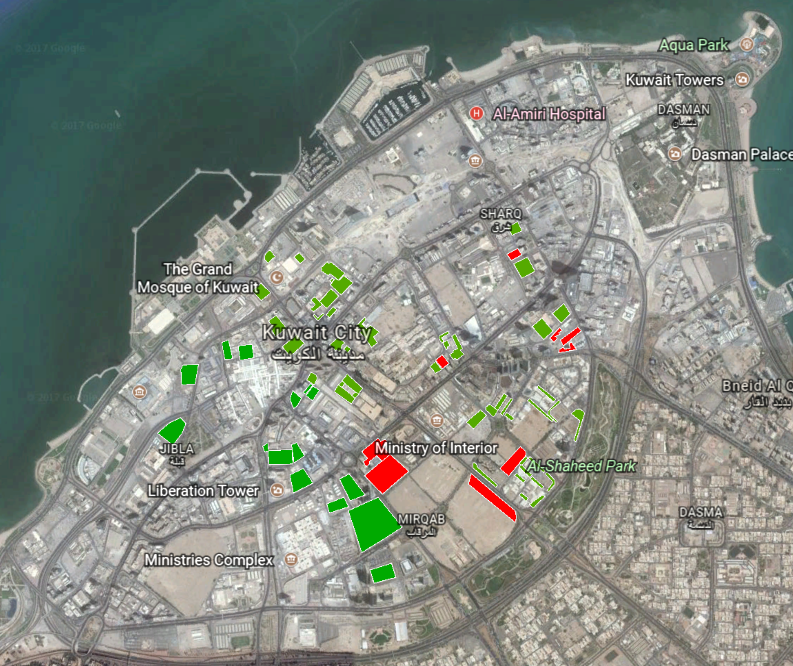
City parking survey (brief) -- Total highlighted area=347,525 m^2:

  1. Green spots: legal parking
  2. Red spots: illegal parking (empty land)

Map of Kuwait City showing green and red areas of parking

Eco Block

An economic block of a city, or convert a city into multiple blocks.
  • Build robotic parking complexes @ city edges
    • Road 30 Entrance (Shamiya Gate)
    • Road 35 Entrance (Shaab Gate)
    • Road 40 Entrance (PIFSS intersection)
    • Road 50 Entrance (Government Mall intersection)
    • Road 80 Entrance (Jahra Gate)
    • Each robotic complex can have 5000+ cars
    • A 15-floor robo complex of 2,972 m^2 area can fit 3,400 cars
    • Wait time to fetch a car: 2-3 minutes tops
    • Multiple entry-exit ports
    • Concurrent robo pallets

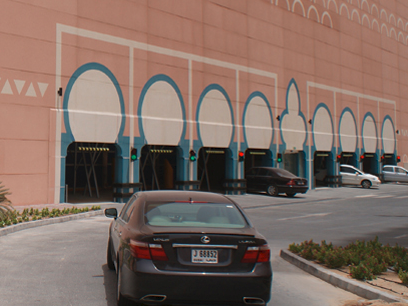
robo parking example
Ibn Batoota mall in UAE providing robo parking

multi entry and exit ports
Wire frame diagram showing multiple entry and exit ports to the parking

Phase 1

  1. Build robo parking complexes @ city edges
  2. Block the entry roads to the city
  3. Use mini-buses to transport people within the city
  4. Demolish parking areas/buildings inside the city and create gardens
  5. Remove street way separators
  6. Use a single lane for mini-buses

Phase 2

  1. Build metro railway or high-speed motorized walking track
  2. Eliminate mini-buses
  3. Reduce street sizes
  4. Plant more greenery

Benefits

  1. No more congestion
  2. Fixed and low time of entry/exit in/out of the city
  3. Robo parking eliminates possible theft in parking spaces
  4. Robo parking eliminates high risk of people slamming your car
  5. Robo parking eliminates need for low-wage security guards
  6. Higher greenery and reshaping the city into a massive garden area
  7. Boosting economy by allowing more businesses to open w/o worrying about parking + greenery attracts people

Future Plans

Upon validating the implementation for the city, expand the idea to other major areas:
  • Hawally
  • Salmiya
  • Farwaniya
  • Free Zone
  • Universities (private and public)
  • Hospital areas (private and public)

Frequently Asked Questions

0) Is there any prior work for this?

Ibn Batoota Mall in Dubai, new Rigae Ministry of Justice in Kuwait and many other global references. None has it on a city-wide scale, though.

Closing Mubarkiya market and Salem Al-Mubarak st. are good examples to how this project expands greenery and boosts economics for shops.

1) Why not build a suspended metro and suspended walk-ways?

The construction will take 3-5 years, during which it’ll cause severe obstruction to the streets, which are already reaching their limits. It’s unrealistic and impractical. The timeline of the construction assumes that everything goes smooth, which to anyone knowing Kuwait, is hilarious and impossible.

2) Why not use empty areas and let people park by themselves or use valet?

Valet = employing a lot of low-wage foreigners, which hurts the country on the long run.
Allowing people to park by themselves is a logistical nightmare. Improper parking, banged doors, and blocked exists are a few common issues.

3) Are people going to pay fees for using the mini-buses or the metro once operational?

Currently people pay for the public and private parking, so the fee to be paid should be for the parking only. The parking ticket should allow for free all-day movement within the city, using mini-buses (initially) and the metro (when built).

4) Is this a public project or private?

It can be a public project owned by Public Utilities Management Company (المرافق العمومية) or privatized. If privatized, entrances should have a different contractor to avoid monopolies and distribute chance to multiple contractors.

5) Some people will refuse to share mini-buses or metro carts with low-wage workers. This idea won’t work.

Instead of shutting down the idea, it’s best to find ways to make it work:
  • It’s possible to have male/female segregated buses/carts.
  • It’s possible to have buses for separate destinations, and since most workers go to specific spots, it’ll reduce clashes.
  • Make separate standing and sitting carts with higher cost for sitting ones. Another form of segregation and preference to those who want some extra space.

6) Why not allow cars to enter the city, but put a high entrance fee (road tax)?

No. Easy access is a right, not a privilege. People must not use this to brag about paying more, getting Wasta* exemptions and what not. Everyone should be treated equally and cars must be banned from accessing the city (apart from emergency vehicles).

* Wasta: An Arabic term referring to getting access to something you weren't supposed to by asking people you know/higher ups.

7) Instead of all this solution and cost, why not force remote work, different working hours, or move companies to another place?

  • Remote Work: Most daily routines involve physical paperwork, thus forcing people to be physically present. Currently impractical in current times.
  • Different Working Hours: Tried and failed. It’ll affect parents who will be forced to have 2-4 trips per day for jobs, schools, and other things.
  • Move Companies: The city is the financial district (banks, stock exchange, ...etc.) and around this, other businesses thrive: IT companies, insurance, investment, restaurants, cafes, hotels, gov offices.
    It’s unrealistic to shift all of this “ecosystem” out, and chopping it (moving specific type of companies) will hurt the ecosystem and probably cause more congestion in Kuwait’s roads as people will have to go drive now to reach the city for meetings and other business requirements.

Feel free to reach out privately, or publicly in comments or on Twitter, to discuss and share ideas. Also, feel free to push this idea with the government. I honestly don't care to have credit, as long as the idea is implemented, though I'd appreciate being involved in the project.

Saturday, September 22, 2012

No More Passwords

Too many websites have been breached in the past 24 months: 21 Sony sites, Gawker, and most recently LinkedIn. A minimum of 20 million passwords were leaked causing chaos on the Internet, from increase in spam originating from legitimate email accounts, to stolen credit cards used for money laundry from stolen emails attached to Amazon, PayPal, eBay and other online payment systems and stores.

This is an article showing what password crackers have done with all those leaked passwords; in summary: Minimal work is now needed to crack 90% of passwords in less than 24 hours!!!

Users are stupid. Fact well established thanks to all those leaks, where users have used the same password for their accounts as the email password. But, for the website developers to also be a failure in understanding proper password hashing & encryption? This is the ultimate failure that users cannot see coming until it's too late.

So why are we relying on passwords still? I own accounts at least 15 different websites and I do not like the idea of Single Sign On where one password allows me to login to all of them. That's simply insecure & risky.

The answer is very simple: We don't need passwords in general. Websites should instead offer authorization/access codes in combination to email addresses to access content. Those codes are auto generated by the website, random, long (128+ characters), and most importantly, the user does not have to input any data nor remember anything. It's important to not tie the code to any user data (salting).

The only thing that needs a password is: Email and online payment systems. Everything else should send its auth code by email. When a user wants to login, they go to their email, open the email that has the code and copy/paste it to login.

In case a website is cracked, then users aren't at risk & the website maintainers can simply regenerate all auth codes and email them to the users.

As for now, I adopted the "make a silly temp password" method. I keep forgetting passwords on purpose and every time, I reset the password and enter a new temporary and random password, until website maintainers cut the crap and ditch this password scheme.

Wednesday, August 3, 2011

Designing Software For The Poor and The Rich

This is just a quick post of an idea I got today about how to kind of "force" people into buying/supporting software companies.

Many a time I come across some software that I need to use only once, or maybe a few times a year only. I don't see a need to pay for that, but maybe someone who uses it very often *should* buy it.

The idea is to create software that gradually slows down (i.e., functions slower/take more time to execute the same functions) the more you use it. If left unused for a while, it gains speed gradually.

This would come in handy for those who use software for commercial use, as they'd be running it very often, unlike hobbyists or one-time users.

I do admit, this is an annoying and evil idea, but there are users out there who don't bother donating for free software that they use very often, yet keep ranting at its bugs!

Oh, and if you're wondering about how the title doesn't fit and it should've been "The Casual & The Avid," well, if you're poor, you won't pay and you'll suffer the slowness. Much like with cars.